


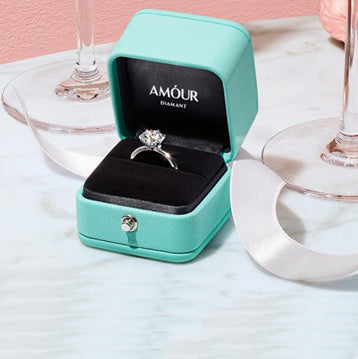
How to Find The Ring Size (Without Ruining The Surprise!)
Finding the right engagement-ring size without asking directly is possible, but some methods are far more reliable than others. The safest approach is to borrow a ring your partner already wears on the same finger and the same hand, then have its inner diameter measured by a jeweller.
Quick answer: Borrow a well-fitting ring from the correct ring finger, measure the inside diameter, and send the measurement to a jeweller. If you cannot do that, discreetly ask a trusted friend or relative to help.

Before you measure: three details that matter
- Use the correct finger and hand. The same finger can differ in size between the left and right hand, especially on the dominant hand.
- Measure the inside of the band. The outer diameter includes the metal thickness and will produce the wrong size.
- Consider the band width. A wider band often feels tighter than a slim band in the same nominal size.
1. Borrow a ring from the correct finger
This is the most dependable surprise-friendly method. Choose a ring your partner wears comfortably on the intended ring finger. Do not use a thumb ring, index-finger ring, or a ring worn on the opposite hand unless you are prepared for a less accurate estimate.
- Borrow the ring briefly when it will not be missed.
- Take it to a jeweller, or measure the inner diameter at the widest point with a precise millimetre tool.
- Share the diameter and the sizing system you need (EU, UK or US) with the jeweller before ordering.

Accuracy tip: If the ring is not perfectly round, measure the inner diameter in two directions and ask a jeweller to confirm the result.
2. Ask a trusted friend or family member
A close friend, sibling or parent may already know the size—or can find it out naturally. Ask someone who can keep the secret and who understands which finger the engagement ring will be worn on. A convincing approach is to try on rings together while shopping for jewellery, then quietly note which size fits.

3. Trace the inside of a well-fitting ring
If you cannot take the ring to a jeweller, place it flat on white paper and trace the inside edge with a very fine pencil. Trace it more than once so the jeweller can check consistency. This is less precise than measuring the actual ring, but it is more useful than guessing from appearance alone.
Another option is to press the ring gently into a clean, soft bar of soap to leave an impression. Only use this on a sturdy ring and clean it carefully afterwards. Avoid this method for delicate, antique or highly detailed jewellery.
4. Create a natural try-on moment
When borrowing a ring is impossible, create a casual reason to try on jewellery. You might browse rings while choosing a gift for someone else, visit a market or jewellery counter together, or ask a friend to compare ring sizes for fun. The objective is to learn the size without making the engagement ring the subject of the conversation.
Methods that are usually too unreliable
- Measuring while your partner sleeps: fingers move, string stretches, and the pressure is inconsistent.
- Estimating from a photograph: perspective and the lack of a precise scale make photos deceptive.
- Using height, weight, glove size or shoe size: none predicts ring size reliably.
- Assuming both hands match: they often do not.
What if you are between two sizes?
For many slim, resizable engagement-ring settings, the slightly larger option is usually safer than a size that may not pass over the knuckle. But this is not a universal rule: wide bands can feel tighter, and eternity bands, tension settings and heavily detailed bands can be difficult—or sometimes impossible—to resize.
Before ordering, tell the jeweller which method you used and how confident you are in the measurement. A specialist can advise whether the design should be ordered exactly, slightly larger, or in a setting that offers more flexibility.

Choose the ring first—we will help with the size
Found a ring you love but only have an inner-diameter measurement or an approximate size? Share what you know with our team before ordering and we will help you choose the most sensible option for that design.
Frequently asked questions
Can ring size differ between the left and right hand?
Yes. The dominant hand is often slightly larger, and knuckle shape can differ from one hand to the other. Measure a ring worn on the intended hand whenever possible.
Can I determine ring size from a photo?
Not reliably. A photo can only help when it includes an object of known, exact size in the same plane as the ring—and even then, lens distortion can affect the result.
Is it better to buy one size larger?
A slightly larger size may be safer when your estimate falls between two sizes, but the right choice depends on the band width, setting and resizing options. Ask the jeweller before placing the order.
What should I send the jeweller?
Send the inner diameter in millimetres, confirm which hand and finger the reference ring fits, describe whether that ring feels snug or loose, and mention the country sizing system if you know it.


Prix total : Monture+Pierre


Prix total : Monture+Pierre


Prix total : Monture+Pierre


Prix total : Monture+Pierre


Prix total : Monture+Pierre


Prix total : Monture+Pierre


Prix total : Monture+Diamant


Prix total : Monture+Pierre


Prix total : Monture+Pierre


Prix total : Monture+Pierre


Prix total : Monture+Pierre


Prix total : Monture+Pierre


Prix total : Monture+Diamant


Prix total : Monture+Pierre


Prix total : Monture+Pierre


Prix total : Monture+Pierre